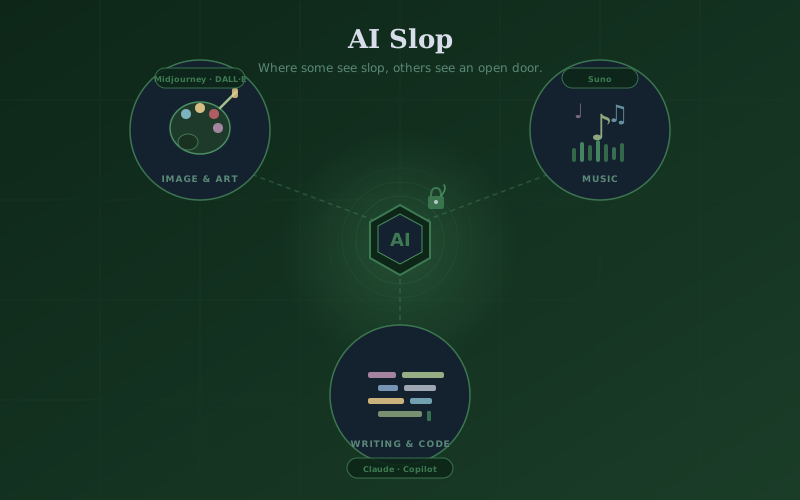
"AI slop" has to be my new favourite superiority catchphrase. I'm hearing and seeing it everywhere: criticism of blog posts, artwork, and code from friends, work colleagues, and online commentators. I recently read a response to an article stating that the commenter would not read it because the image was generated by AI, or "AI Image Slop" as they put it. I thought that was a really weird line to draw. To be fair, I've quietly dropped off most social media platforms myself, driven out by a constant feed of AI-generated rage bait.
But I also see another side.
My sister has a fine arts degree and runs a performing arts company. My brother acted. My cousin is an architectural model maker, and anyone visiting the Perth Museum would recognise his handiwork. My sister-in-law, amongst many other talents, is the illustrator behind the Jess Learns to Code books. My grandfather was a professional opera singer with a residency at Covent Garden. And then there's me. I'm completely talentless in all these areas. My primary school music teacher once noted that I'd traded pitch and tone for volume. I used to joke that I'd had my graphics chip removed to fit a bigger maths processor, though that one's lost some of its shine since the whole GPU explosion.
So, back to AI.
Images and the mind's eye I never had
My first real exploration came a few years ago with image generation. I have aphantasia. I can't visualise images in my mind at all, even when I close my eyes and try. There's no mind's eye to speak of. So the idea of translating some internal mental picture onto paper was never really the barrier; the barrier was simply that I had no artistic ability whatsoever. Then I discovered Midjourney and DALL·E, and my mind was blown. With a few longer-than-necessary prompts, drawings, paintings, and cartoons were appearing right in front of me. I know my sister and the other talented members of my family worked hard to develop their craft, and still do, and I respect that deeply. But there was always an underlying talent there that I sadly missed out on.
The Christmas song I could finally make
Then came Suno, and suddenly I could turn simple ideas into music. I made a Christmas song for my wife about how we met and our shared love of the season. Sure, I could have stuck with the guitar lessons, the drum lessons, and practised, practised, practised, but the honest truth is I was hopeless. Here, finally, I could take the constant ideas floating around in my head and turn them into music, in any genre I can imagine.
Writing when words don't cooperate
Then there's work, where AI has exploded in the last six months, with writing documents, making presentations, and coding.
Being dyslexic, I've always struggled with written communication. No matter how many times I proofread, I miss words, misspell things (words just randomly vacate my head, especially the non-phonetic ones), make simple grammar mistakes, and run off on tangents. Okay, that last one is more the ADHD. Unlike most people, my biggest work-related fear isn't public speaking. It's public writing. Speaking is still a little nerve-wracking, but if you really want to unsettle me, ask me to write a LinkedIn post on behalf of the company.
Now I can hand AI my drafts, ask it to proofread and make them coherent, and the result is something people can actually read and understand. I know some people don't like the flow of AI-polished writing, but I actually do, possibly my neurodivergence again, but I appreciate the structure and rhythm. And it means I no longer have to suffer the particular embarrassment of calling the printers to pull a job because of a spectacularly bad spelling mistake.
Code without the rabbit holes
Then there's AI-assisted coding, the big one for me personally. I've built a career working in and around software development teams and genuinely love it. I love code, I love the creative problem-solving, and I love working with engineers. But like most people juggling work and home life, I barely have time for personal projects, and if I'm being honest with myself, I don't really have the inclination or patience anymore to spend a couple of hours hunting a bug or untangling a logic loop.
AI changes that completely. I can focus on the creative side, dip into the code to make targeted changes, then step back and try a new idea, all while manning the BBQ or training the puppy.
An open door
So where some people see slop, I see enablers. Time-savers. A way for people who were previously locked out, by talent, time, or neurology, to finally participate.
This post took me about 54 minutes to write, 45 of those minutes spent trying to figure out how to spell "genre" (I really do hate non-phonetic words, while also appreciating the irony that "phonetic" is not spelled phonetically). It took Claude less than a minute to fix up and make readable.
Reactions & comments
Tap a reaction, or leave a comment below — sign in with GitHub. Keep it kind and constructive.