Recently I have been building my own AI OS. The idea is simple enough: a local LLM fields the initial questions and handles what it can, then packages up anything it can't action and sends it on to Claude. Around that core I built tools and routines to manage my website, spin up new apps and games, and help with blog posts like this one.
One of those tools was a research feature. It does a deep dive on a topic, asks clarifying questions, and only returns findings that can be cross referenced against trusted sources. I also built it to strip out confirmation bias, so if I ask it something like "how does renewable energy give my dog autism," it doesn't play along. It just tells me it couldn't find any scientific evidence to suggest that, and moves on.
Here is the thing though. The AI OS was one of many projects I had on the go. My list of "best idea ever" was growing at an increasing rate, and almost none of them were getting finished.
So I decided to test the research feature on myself.
Asking the uncomfortable question
I started with a broad one: are there any studies on the negative impacts of AI when it comes to constant context switching, never taking one idea through to completion before starting the next?
There were.
Context switching, moving between unrelated tasks without finishing them, is neurologically costly for everyone. Research from Mark, Gudith and Klocke found it can take over twenty minutes to regain full focus after an interruption. That is twenty minutes of cognitive cost every single time you jump tracks.
So I asked the next question: do certain groups, like neurodivergent people, have a bigger problem with this than others?
They do. And this is where it got personal, being neurodivergent I've found that AI tools have genuinely expanded what I can create and participate in. But the same traits that make AI feel like a superpower are exactly what make it a trap.
For ADHD brains specifically, the research (Monsell, 2003) shows that task switching activates the same neural pathways as starting something new. Read that again, because it floored me. Abandoning a project and starting a fresh one feel neurologically identical to progress. Your brain rewards you for jumping ship as if you had just shipped something.
And AI pours fuel on that fire. It does not just allow context switching, it actively rewards it:
- It instantly generates new project ideas, so the old one feels stale by comparison
- It never says "finish what you started," so there is no external accountability
- It makes starting feel effortless, removing the friction that might otherwise slow an impulsive new start
- It offers endless rabbit holes
- Most tools remember nothing between sessions, so every session feels like a fresh, exciting start
The report even described a scenario almost word for word from my own life. You open AI to work on one project. It answers a question. That answer sparks an idea for something else. You open a new chat. Forty minutes later you are designing a UI for an unrelated app and the original thing is untouched.
Sound familiar? It did to me.
The dopamine machine
Now, I have the advantage of being incredibly self aware, helped along by 33 years of marriage and a wife who is generous with reminders of my faults. So I could see what had actually been happening.
I had been using AI as a dopamine machine. Every new idea got an instant hit. It was validated, confirmed, prototyped and "complete" within minutes. The reward came at the start, never at the finish. I was collecting beginnings. I wasn't closing anything out or taking a single product all the way through to completion.
I was collecting beginnings. The reward came at the start, never at the finish.
The reward pathway research backs this up. Volkow and colleagues (2011) linked motivation difficulties in ADHD to dysfunction in the dopamine reward pathway. Generating new ideas with AI triggers exactly those reward pathways. Novelty equals stimulation. And AI is an infinite novelty engine.
So I asked one more question
Are there any proven methods or practices that help?
There were, and the research laid them out with clear steps. A few of them have genuinely changed how I work:
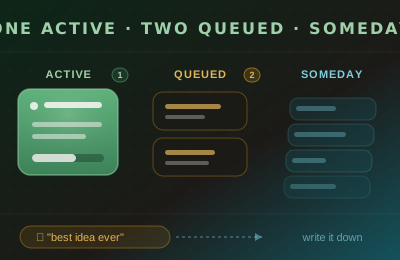
One active, two queued
Keep exactly one project active. Allow two in a clearly labelled queue, and everything else goes into a "someday" list. When AI sparks a new idea, and it always will, you write it down immediately. That satisfies the urge to capture it without letting it hijack what you are actually doing.
Use AI as an accountability partner, not just a generator
I now start sessions by stating the active project and the one goal for that session, and I ask the AI to pull me back if I start drifting. It is a tiny contract with myself, witnessed by the machine.
Name your rabbit holes before you fall in
The simple act of writing "I am about to go down a rabbit hole about X" adds just enough friction to make it a choice rather than a reflex.
Set a definition of done before you start
One sentence describing what finished actually looks like. Neurodivergent brains, mine included, often do not get the natural "it's complete" signal, so projects feel unfinishable and get abandoned. A pre agreed endpoint fixes that.
Closure rituals
When something is genuinely done, mark it. Write a completion summary, archive it, and tell someone. That external acknowledgement is a powerful substitute for the completion reward signal that can be muted in neurodivergent brains.
Where I landed
That last point is partly why I am writing this post. Telling someone is the ritual.
Introducing these practices has actually started to change things. I have worked through my board of half finished projects, and I am down to three. Three. Once those are closed out, I get to start something new, properly, on purpose.
AI is a remarkable tool and it can help us achieve an enormous amount. But to get the best out of it, we have to understand ourselves first. Play to our strengths and be honest about our weaknesses. The tool was never the problem. The problem was that I was letting a machine that is very good at starting things convince me that starting was the same as finishing.
It isn't.
References
- Mark, G., Gudith, D., & Klocke, U. (2008). The cost of interrupted work: More speed and stress. Proceedings of the ACM CHI Conference on Human Factors in Computing Systems.
- Monsell, S. (2003). Task switching. Trends in Cognitive Sciences, 7(3), 134–140.
- Volkow, N.D., Wang, G.J., Newcorn, J.H., et al. (2011). Motivation deficit in ADHD is associated with dysfunction of the dopamine reward pathway. Molecular Psychiatry, 16, 1147–1154.
More on the projects I'm actually finishing over on the Apps & Games page, or head back to the blog.
Reactions & comments
Tap a reaction, or leave a comment below — sign in with GitHub. Keep it kind and constructive.